Chinese-Made Components in Military Drones: What the MoD Data Breach Near-Miss Reveals About Hardware Supply Chain Risk



The Royal Navy's K3 Scout incident is not a procurement anomaly.
It is a demonstration of a structural vulnerability running through Western military drone programmes: one that existing compliance frameworks are not built to catch.
In August 2026, it emerged that cameras aboard the Royal Navy's fleet of K3 Scout uncrewed surface vessels had been transmitting automated "heartbeat" signals to an IP address located in China [1]. The fleet comprises approximately 20 vessels valued at roughly £12 million, introduced with Royal Marines elements in March 2026 as part of Project Beehive, the Royal Navy programme building hybrid formations of crewed and autonomous systems [1]. The vessels are capable of surveillance, maritime awareness, force protection, logistics, and precision strike missions, and the K3 Scout has participated in NATO Baltic Task Force X activities [1]. The cameras had been represented as compliant with the National Defense Authorization Act (NDAA), a certification meant to exclude components from designated Chinese manufacturers. That certification failed to prevent Chinese-origin hardware from entering the system. As the supplier Kraken Technology Group acknowledged, a small number of components inside the cameras originated outside the UK, despite the equipment being considered compliant with relevant US defense procurement requirements [2].
The Ministry of Defence (MoD) stated that a routine cyber vulnerability assessment detected the issue, and "a thorough investigation found no evidence of MoD data or systems being accessed, compromised or transmitted externally." [1] Internet connectivity was removed from the affected cameras as the immediate remediation measure [2]. The MoD also noted that "some camera functions may have remained active while vessels were otherwise powered down" [2], a detail with direct operational implications. Shadow Security Minister Alicia Kearns put the problem plainly: "If we cannot say with confidence what is inside our own military equipment, we cannot say it is ours, or that we are sovereign." [1]
The core failure here is not that a supplier introduced a prohibited part. It is that NDAA compliance operates at the manufacturer level, not the subcomponent level. A product can comply with rules prohibiting equipment from specified manufacturers while still incorporating components produced in countries viewed as security risks [2]. This is the gap: tier 1 supplier certification does not propagate assurance down to tiers 3, 4, or 5, where Chinese-origin inputs are often indistinguishable from domestically sourced material without forensic-level inspection.
This incident sits within a broader pattern of MoD third-party and supply chain exposure. In early 2024, the MoD suffered a separate breach when a payroll system operated by contractor Shared Services Connected Ltd (SSCL) was compromised [3]. Defence Secretary Grant Shapps disclosed the breach to the House of Commons on May 7, 2024, stating that "we do have indications that this was the suspected work of a malign actor and we cannot rule out state involvement." [3] The breach potentially exposed the personal data of up to 272,000 current and former armed forces personnel, including names, bank details, and in some cases home addresses [3]. The MoD confirmed "evidence of potential failings" by SSCL, and much of the compromised data was not encrypted [3]. No formal public attribution was made by the UK government, though UK government sources cited by broadcasters suspected China-linked actors. China's embassy denied involvement, calling the allegations "fabricated and malicious slander." [3]
Two separate incidents, two separate third parties, two different exposure vectors. The pattern is the point.
The structural reason this problem persists is China's dominance across drone-critical supply inputs. As Figure 1 illustrates, data from the Silverado Policy Accelerator presented by the Association for Uncrewed Vehicle Systems International (AUVSI) shows China controls 93% of processed rare earths, 92% of polysilicon production, and 70% of capacitor manufacturing globally [4]. These are not peripheral inputs. They are foundational to propulsion, power management, sensor function, and communications across nearly every drone platform in service with Western militaries. The U.S. Department of Defense has initiated strategies to develop a domestic "mine-to-magnet" rare-earth supply chain by 2027 [5], but that target remains aspirational rather than operational.
China has further tightened its position. On August 5, 2026, China's Ministry of Commerce announced that exports of drones, key drone components, and related technologies on China's dual-use export control list destined for the US will now require rigorous case-by-case review and will no longer be eligible for license facilitation measures [6]. This creates deliberate friction precisely where Western defence programmes are most dependent.
The offensive environment in which these supply chain gaps exist makes the exposure materially worse. A 2026 adversary tracking report records an average eCrime breakout time of 29 minutes, with the fastest recorded breakout at just 27 seconds [7]. AI-enabled adversary attacks increased 89% year-over-year in 2025 [7]. China-nexus activity increased 38% overall, with logistics sector targeting up 85% [7]. In that environment, a component that periodically signals its location to a Chinese IP address is not a dormant risk. It is an active intelligence collection opportunity during the precise window before detection occurs.
The counterfeit parts dimension extends this risk further. A US Senate Armed Services Committee investigation found that large defense contractors reported 1,800 cases of suspected counterfeit parts covering a total of 1 million individual parts over a 2-year period [8]. More than 70% of traced counterfeit part supply chains led back to China [8]. These were not cheap consumer goods. Suspect counterfeit memory devices were found in THAAD missile computers, with remediation costing nearly $2.7 million [8]. Raytheon only discovered suspect counterfeit parts in FLIR units on the SH-60B helicopter after being alerted by the committee's investigation, not through its own internal processes [8]. As Xilinx noted in written testimony, "though the devices may initially function, it may be next to impossible to predict what amount of life is remaining or what damage may have been caused to the circuitry." [8] The K3 Scout incident involves known components that behaved unexpectedly. Counterfeit parts compound the problem by introducing components whose identity and behavior cannot be assumed from their markings at all.
Policy responses are moving, but lagging exposure. The US Federal Communications Commission (FCC) added foreign-made Uncrewed Aircraft Systems (UAS) and UAS critical components to its Covered List on December 22, 2025, following a White House-convened interagency national security review [9]. The covered components include:
- data transmission devices
- flight controllers
- navigation systems
- sensors
- cameras
- batteries
- motors [9]
Section 805 of the FY24 NDAA prohibits the Department of Defense from contracting with companies on the Section 1260H list of Chinese military companies, extending to sub-tier suppliers, with enforcement deadlines extending to June 30, 2027 [4]. The US DoD's Cybersecurity Maturity Model Certification (CMMC) programme has moved from voluntary self-attestation to a contractual prerequisite for Defense Industrial Base participation [10], with NIST SP 800-171 Rev. 3 now explicitly introducing enhanced emphasis on supply chain risk management and third-party oversight [10].
These are meaningful steps. But they share a common constraint: they regulate at the manufacturer or tier-1 supplier level. The K3 Scout cameras were NDAA-compliant at point of purchase. The compliance framework assessed the camera as a product, not the camera as an assembly of components with independent provenance. This is where regulation consistently falls short of the actual attack surface.
The operational implication is direct. Hardware bills of materials (HBOMs) and component-level provenance verification need to become baseline procurement requirements for defence drone programmes, not post-deployment audit tools. Software Bills of Materials (SBOMs) for UAS remain limited in adoption due to industry fragmentation and absent binding regulatory drivers [11]. The hardware equivalent is less advanced still. Without component-level visibility, procurement teams are certifying systems they cannot fully characterise.
The K3 Scout case is significant not because data was confirmed exfiltrated. It is significant because it demonstrates that Chinese-origin hardware reached active Royal Navy platforms carrying NATO operational exposure, passed compliance checks, and was only detected through routine cyber vulnerability assessment rather than procurement-stage vetting [1]. The Five Eyes alliance has issued coordinated warnings about Chinese state-sponsored espionage targeting defence contractors and critical infrastructure [12]. The NCSC's Supply Chain and Cyber Directorate has identified autonomous systems as one of five critical technology sectors presenting the greatest supply chain risks to US economic and national security [13].
Programme managers and procurement teams in defence organisations need to treat hardware provenance as an intelligence problem, not a paperwork problem. Supplier assurances and compliance certificates describe what a vendor believes is in their product. Component-level verification describes what is actually there. For platforms carrying weapons, operating alongside special forces, or integrated into NATO networks, the gap between those two things is the risk.
The lesson is not confined to military hardware. The same tier structure gap applies equally to enterprise IT equipment, operational technology, and any connected hardware whose supply chain extends into the same inputs: tier 1 compliance certifies a product without propagating assurance to the subcomponents inside it. China controls 93% of processed rare earths, 92% of polysilicon, and 70% of capacitors globally [4]. Those materials do not stop at drone platforms. They underpin the servers, network equipment, and connected systems across corporate and critical infrastructure environments. For any organisation whose leadership is asking what this incident means for them: the question is not whether the principle applies. It does. The question is whether procurement is designed to verify hardware at the component level, or only at the product level. The K3 Scout cameras passed compliance checks. What was inside them did not.
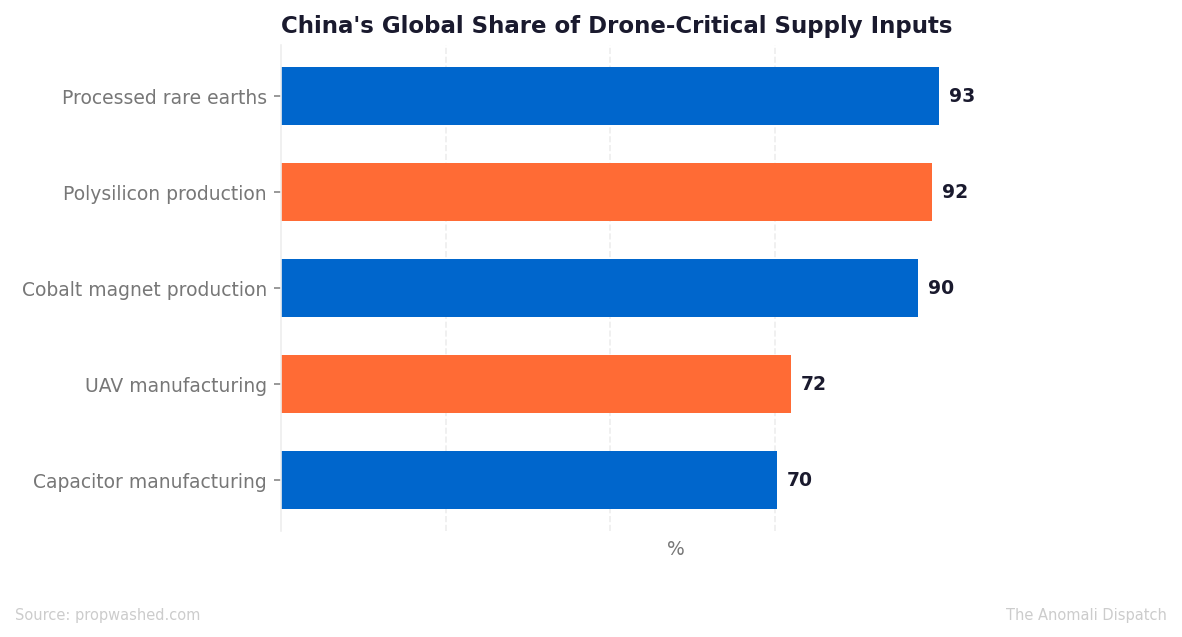
Figure 1: China's percentage share of global production across five drone-critical supply categories, ranging from 70% to 93%, as reported by Silverado Policy Accelerator data presented by AUVSI [6].
References
- Defence Security Asia, "Royal Navy K3 Scout Drone Security Scare: Chinese Components Sent Signals to China, Exposing Critical Vulnerability in Britain's Autonomous Warfare Fleet," Defence Security Asia, 10-Aug-2026. https://defencesecurityasia.com/en/royal-navy-k3-scout-drone-chinese-components-china-cybersecurity/ [Accessed 14 Aug. 2026].
- Unknown (summary/analysis article, original reporting by The Telegraph), "Royal Navy Uncrewed Vessels Found with Cameras Communicating with Chinese IP Address," 2025. https://www.zerohedge.com/technology/spy-cams-uk-navy-drones-secretly-transmitted-data-china [Accessed 14 Aug. 2026].
- BBC News, "Royal Navy drones had cameras sending data to China," BBC News, Aug. 2026. https://www.bbc.co.uk/news/articles/c4gwl3n7ne7o [Accessed 14 Aug. 2026].
- L. Danielson, "UK Ministry of Defence Data Breach," Huntress, Nov. 16, 2025. https://www.huntress.com/threat-library/data-breach/uk-ministry-of-defence-data-breach [Accessed 14 Aug. 2026].
- FPV News, "FCC Drone Ban Broadens: Pentagon Ramps Up Supply Chain Scrutiny by 2026," FPV News, May 18, 2026. https://propwashed.com/fcc-drone-ban-broadens-pentagon-ramps-up-supply-chain-scrutiny-by-2026/ [Accessed 14 Aug. 2026].
- A. Neumann, "Elon Musk's Drone Supply Chain Comments Ignite Industry Debate," DroneNews24, 28-Apr-2025. https://www.dronenews24.com/de/news-posts/elon-musks-drone-supply-chain-comments-ignite-industry-debate [Accessed 2025].
- Xinhua News Agency, "China strengthens export controls on drone-related dual-use items to U.S.," Xinhua News Agency, 2026-08-05. https://english.news.cn/20260805/88c4bb2116cf4407b6c250260e5ebef5/c.html [Accessed 14 Aug. 2026].
- CrowdStrike, "CrowdStrike 2026 Global Threat Report: Year of the Evasive Adversary," CrowdStrike, 2026. https://www.crowdstrike.com/en-us/global-threat-report/ [Accessed 14 Aug. 2026].
- U.S. Government Publishing Office, "The Committee's Investigation into Counterfeit Electronic Parts in the Department of Defense Supply Chain," 2011-11-08. https://www.govinfo.gov/content/pkg/CHRG-112shrg72702/html/CHRG-112shrg72702.htm [Accessed 14 Aug. 2026].
- Federal Communications Commission (FCC), "FCC Covered List: UAS and Uncrewed Aircraft Systems FAQ," 2026-07-21. https://www.fcc.gov/supplychain/coveredlist [Accessed 14 Aug. 2026].
- M. E. S. Bernard, "CMMC 2026: Executive Governance Framework for Defense Industrial Base Cybersecurity Compliance," Bernard Institute, 2025. https://www.linkedin.com/pulse/cmmc-what-us-department-defense-expects-from-2026-mark-e-s--x1vjc [Accessed 14 Aug. 2026].
- B. Sugg, "SBOM Software Bill of Materials Hardware Components Military Drone Security," CNA, unknown. https://www.autonomyglobal.co/inside-the-drone-software-supply-chain-software-bills-of-materials-expose-hidden-vulnerabilities/ [Accessed 14 Aug. 2026].
- E. Vasquez, "Five Eyes Alliance Issues Sweeping Warning on Chinese Espionage Threat," Political.org, Jun. 3, 2026. https://political.org/2026/06/03/five-eyes-alliance-issues-sweeping-warning-on-chinese-espionage-threat/ [Accessed 14 Aug. 2026].
How Anomali Can Help
Hardware supply chain risk from Chinese-made drone components demands dark web intelligence, adversary monitoring, and C2 detection to catch exfiltration before a near-miss becomes a breach.
- Anomali C2 Detection provides outside-in visibility of compromised hosts beaconing to the adversary command-and-control infrastructure described above, identifying affected systems even before internal endpoint tooling fires.
- Anomali's dark web and advanced threat intelligence provides coverage that commodity feeds do not reach, nation-state actor attribution including Iranian-nexus groups, pre-ransomware initial access broker detection with a 24–72 hour warning window, outside-in compromised host visibility, and dark web credential monitoring, all surfaced inside ThreatStream as enriched, actionable intelligence.
- Anomali's adversary monitoring intelligence delivers APT-attributed IOCs with full threat context, actor attribution, malware family, TTP mapping, and targeting data, enabling analysts to enrich alerts with adversary attribution and prioritise incidents tied to the groups described in this article.
Does your current stack detect C2 activity and adversary movement tied to hardware supply chain compromises like this?
Talk to Anomali.
FEATURED RESOURCES

When One Phishing Click Costs 1.3 Million Records: The Converging Threats State Governments Cannot Ignore