
The average organization runs 83 security tools from 29 different vendors, according to a 2025 study from the IBM Institute for Business Value. Each tool records the same events in its own vocabulary: a user in one system is a principal in another, a laptop is a host here and an instance there. Before an analyst can correlate activity across those tools, someone has to reconcile the vocabularies. That reconciliation work is the tax the Open Cybersecurity Schema Framework was built to remove.
What is the Open Cybersecurity Schema Framework (OCSF)?
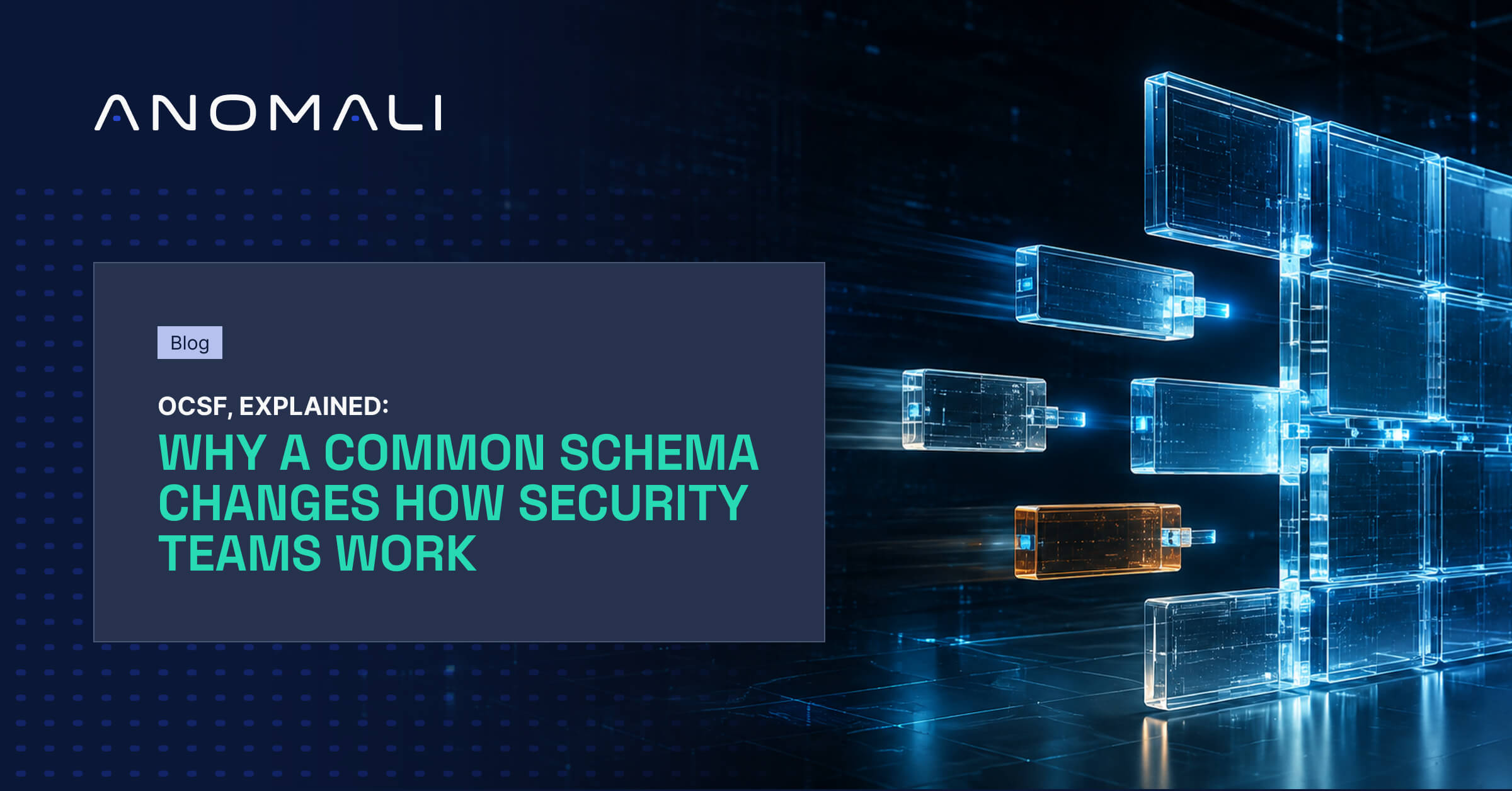
OCSF is an open, vendor-neutral schema that gives security products a common structure for describing events, findings, and objects. Instead of each product inventing its own field names, vendors map their output to one shared model. A login, a process launch, or a file write then looks the same regardless of which tool reported it.
OCSF launched in August 2022, built on schema work originally done by Broadcom's Symantec division. It standardizes the parts of a security event that every tool represents differently: what the actor is called, how a device is identified, how time stamps and severity are formatted. Normalizing security telemetry into that single structure is what makes faster investigation, consistent analytics, and reliable AI possible downstream.
How Schema Drift Slows Investigations
Schema drift is the accumulation of small, inconsistent naming and formatting differences across security tools that make one event look like several. A single suspicious login might be recorded against a host by the endpoint platform, an instance by the cloud provider, and a device by the identity system. One event, three descriptions.
Before an analyst can investigate that login, they first have to confirm all three records point to the same asset. That translation step repeats across every process that depends on correlating data: investigations, dashboards, threat hunts, detection engineering, and automated response.
Consider a detection engineer at a regional bank writing a rule to catch credential abuse. The endpoint agent logs the machine as a host, the cloud platform logs the same machine as an instance, and the identity provider calls it a device. To make one rule fire on all three, the engineer either maintains three versions of the logic or hand-maps the fields each time a new source shows up. Multiply that across a few hundred rules and most of the team's week goes to plumbing rather than detection. A shared schema removes the question of what a field means, so the engineer writes the rule once and the analyst starts with the behaviori nstead of the field mapping.
How is OCSF-Native Ingestion Different From Normalizing Date Later?
OCSF-native ingestion converts every source into the shared schema the moment data arrives, instead of translating formats during each query. Many organizations normalize after data lands in the SIEM or data lake. That works eventually, but it forces every search, dashboard, and detection rule to carry the translation logic for inconsistent source formats. Normalizing at ingest does that work once.
The difference shows up in a single field:
After ingestion, every detection rule, hunt, dashboard, and investigation references the same field, regardless of where the telemetry originated. The analyst writing a query no longer needs to know which product it came from.
Why Deduplicating Events at Ingest Matters
Deduplication at ingest removes redundant copies of the same event before they reach storage, which lowers storage cost and speeds up every query that runs against the data afterward. Multiple products routinely report the same activity. Stored raw, those duplicates inflate the dataset and force analysts to review the same event several times.
Stripping duplicates during ingestion keeps the stored dataset closer to the set of things that actually happened. Searches return faster because there is less to scan, and analysts spend their attention on distinct activity rather than repeated records.
How a Common Schema Improve Analytics and AI-Driven Security
When every source follows one schema, a detection engineer writes a rule once and it runs across endpoint, cloud, identity, and network data without separate logic foreach vendor's format. Threat hunters search one structure instead of learning many. Dashboards stay maintainable because every feed speaks the same language.
This matters more as security operations take on AI agents and automated response. An agent given inconsistent fields spends effort guessing what each one means before it can act, and an agent that acts on misread data makes wrong calls faster than the analyst it was meant to assist. Give that same agent a consistent schema and the effort goes into correlating events and identifying threats instead. AI-driven detection is only as dependable as the data feeding it, and OCSF is one way to make that data dependable by default.
Adopting OCSF Doesn’t Mean Replacing Your Security Tools
OCSF standardizes how security tools describe events while leaving the tools themselves in place. Your endpoint platform, cloud provider, and identity system keep running. OCSF only governs the shape of the data they emit.
The precedent is the shipping container. Before 1956, cargo moved piece by piece, and every transfer between truck, train, and ship meant unpacking and repacking by hand. Malcolm McLean's idea was to standardize the box rather than the goods inside it. When his converted tanker Ideal-X sailed from Newark to Houston in April 1956 carrying 58 containers, the cost of loading a ton of cargo fell from $5.86 to about 16 cents, according to economic historian Marc Levinson's history of containerization, The Box. The container never dictated what anyone shipped; it gave every carrier one shape to handle, so a box could cross truck, rail, and ship without being opened.
OCSF is that box for security data. Rather than dictating which tools you run or what they collect, it gives every source one shape, so an event can move from detection to threat hunting to analytics to an AI agent without being re-parsed at each handoff. The tools stay in place. The friction between them drops.
OCSF as the Security Industry Standard
OCSF has moved from a single-vendor initiative to a broadly governed open standard. The project began in August 2022 with 18 founding companies. By the time it joined the Linux Foundation in November 2024, it counted more than 200 participating organizations and over 900 contributors, according to the Linux Foundation, spanning technology vendors, enterprises, government agencies, and universities.
Companies including AWS, Cisco, IBM, and Splunk actively contribute to the framework. The move to Linux Foundation governance in November 2024 put the schema under neutral, community-run stewardship, which reduces vendor lock-in and lets teams add new data sources without rebuilding pipelines each time. Rather than adding one more proprietary format to the pile, OCSF gives an increasingly varied set of security products a way to interoperate.
Changing the Way Security Teams Work
OCSF turns each new data source from an integration project into a mapping exercise. As teams keep adding cloud services, security products, and telemetry sources, a common schema keeps the cost of onboarding roughly flat instead of letting it compound with every integration.
Normalizing and deduplicating telemetry at ingest gives detection engineering, threat hunting, analytics, and AI a consistent foundation to run on. Anomali normalizes sources to OCSF and removes duplicates before data reaches the lake. Teams that adopt a common schema stop maintaining translation logic across their stack and get that time back for detection and response.
The IBM and Palo Alto Networks study put security fragmentation at roughly 5% of annual revenue. A common schema is one way to take part of that back. See how Anomali applies OCSF at ingest, and what it changes for your detection quality and retention costs.
FEATURED RESOURCES

When One Phishing Click Costs 1.3 Million Records: The Converging Threats State Governments Cannot Ignore