
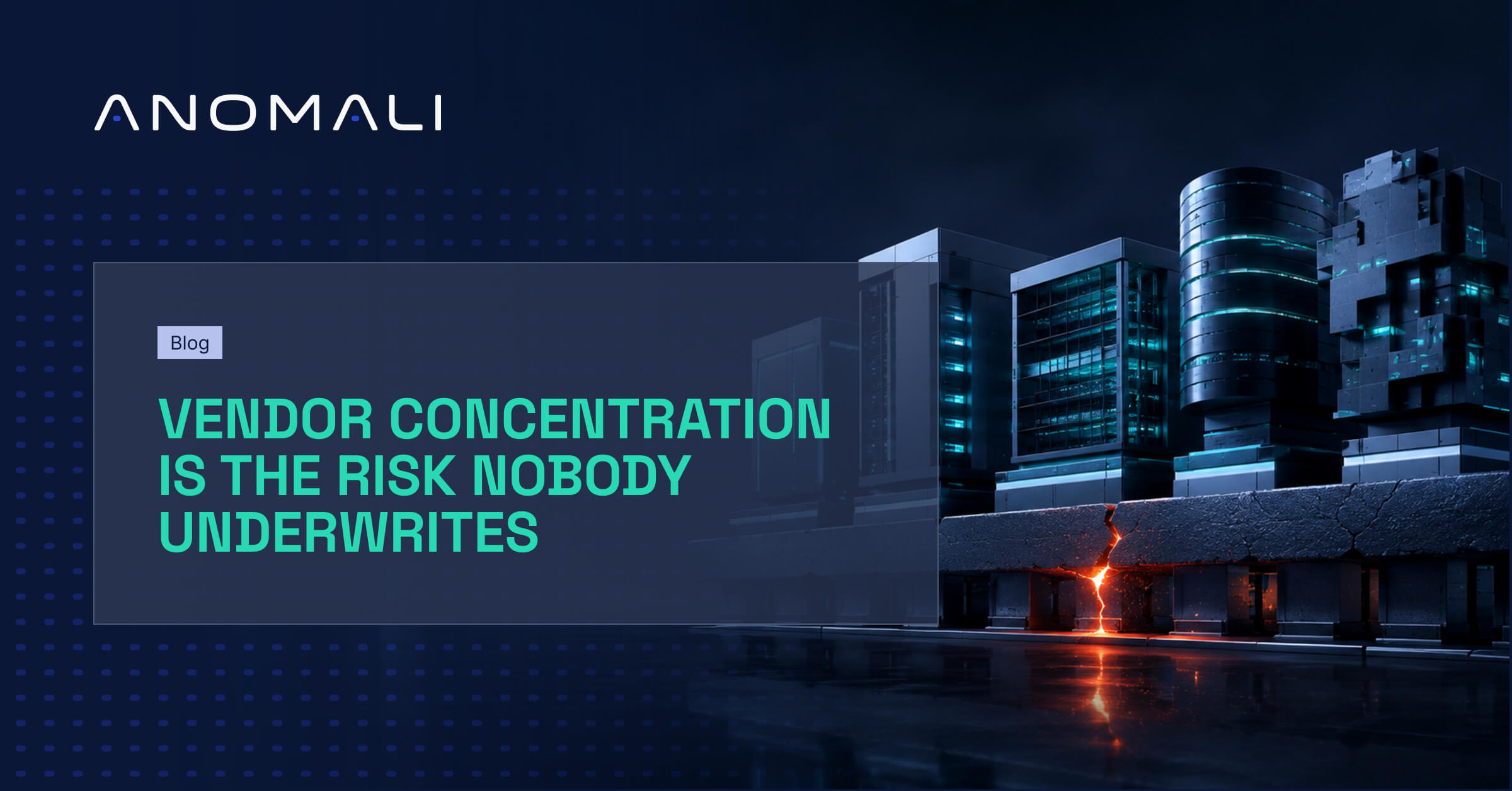
The morning of July 19, 2024, gate agents at Delta, radiologists mid-shift, and 911 dispatchers all hit the same blue screen within minutes of each other. One security vendor had pushed one faulty update, and roughly 8.5 million Windows devices went down with it, by Microsoft's estimate. Each organization had separately concentrated a critical dependency in the same place, and found out only when the screens went dark.
The bill came later. Parametrix put the direct loss to the U.S. Fortune 500, excluding Microsoft, at $5.4 billion, about $44 million per affected company, and estimated cyber insurance would cover only 10 to 20 percent of it. The rest sat on the balance sheets of the companies that had put that much of their operation behind one vendor.
What is Vendor Concentration Risk?
Vendor concentration risk is the financial and operational exposure a company takes on when one supplier sits underneath multiple critical systems, so that the vendor's failure becomes the company's failure. It usually stays invisible until the incident, when you learn how much of your operation depended on a supplier you never modeled as a single point of failure. The 2024 CrowdStrike event, one of the largest IT outages on record, made that exposure legible. CyberCube flagged it as potentially the cyber-insurance market's worst loss in two decades, and most of the damage went uninsured.
How Security Consolidation Increases Financial Fisk
The same design that simplifies buying concentrates the blast radius. The market wants consolidation: one vendor for SIEM, endpoint, identity, and cloud, one contract, one number to call. But when a single platform owns multiple layers, an outage becomes systemic, a pricing change becomes a captive negotiation, and a decade of acquisition-driven architecture debt becomes your problem to carry.
Vendor concentration is recognized concern; financial services it is now a regulated discipline. The EU's Digital Operational Resilience Act, which entered into application on January 17, 2025, requires financial entities to evaluate ICT concentration risk, including reliance on non-substitutable providers, before entering a contract, and to maintain a register of every technology dependency. In November 2025, the European Supervisory Authorities named the first 19 critical ICT third-party providers, a list dominated by hyperscale cloud providers, and placed them under direct EU oversight. The reasoning is concentration in a small number of dominant providers is a systemic threat that firm-level due diligence alone cannot address. Security teams outside financial services are not bound by DORA, but the logic doesn’t stop at neat vertical lines.
How to Measure Concentration Risk
Start by mapping which vendors sit underneath which critical systems, then find the layers where one vendor is the only thing holding the system up and cannot be swapped out without a rebuild. Concentration is not the number of vendors you carry, but the number of critical systems that fail together when one of them fails. The sharpest version of the question is the one DORA's designation criteria turn on: substitutability. If a vendor went dark tomorrow, could you stand the function back up on someone else's infrastructure, and what would the uninsured portion of that outage cost while you did?
A neutral platform makes a different trade. It covers the security layers without owning the cloud you run on, the productivity suite your employees live in, or a prior claim on your infrastructure. That neutrality works as a risk control in its own right. Your data layer does not answer to the commercial priorities of a hyperscaler that also sells you email, compute, and now security, and that can reprice the bundle whenever its roadmap shifts.
Diversifying Doesn’t Have Recreate the Fragmentation Problem Consolidation Was Meant to Solve
Operational consolidation and financial concentration are different axes. You can run one data layer and one console while still refusing to let any single vendor own a layer you could not independently replace. The fragmentation problem is too many tools that never talked to each other. The concentration problem is one vendor holding your data, your controls, and your exit at the same time. Solving the first by creating the second swaps an operational headache for a balance-sheet risk, which is the trade the 2024 outage repriced.
CISOs need to know what happens to the business when that vendor fails, and how much of that failure lands on you rather than an insurer. Diversifying critical dependency is standard discipline in every other corner of enterprise risk. Security has earned its turn at the same scrutiny.
Security is, at its core, about preventing and mitigating risk. Consolidation is worth having, but risk can increase when a consolidation puts your whole stack, your data, and your negotiating position in one vendor's hands. Before your next platform renewal, list your critical systems, mark the ones where a single vendor is the only thing keeping them up, and price what an outage of each would cost after insurance pays out. If one name sits under more than a few of those lines, you likely hold a concentration position, whether or not you ever decided to take one. Use that as a map for your board to see before the next contract, not after an incident.
Anomali's platform sits on top of the stack you already run, covering the security layers without owning your cloud, your productivity suite, or your data's exit. To see where a neutral data layer fits against your concentration map, start here.
FEATURED RESOURCES
AI Ethics at the Edge of Agency: What Philosophy, Theology, and Common Sense Teach Us About the Limits We Must Set on Artificial Intelligence