

Every security operations team runs on trust decisions, even if nobody calls them that. Someone decided the phishing playbook could quarantine messages without asking. Someone approved the automation that auto-closes alerts from a known internal scanner. Someone signed off on letting the EDR isolate hosts after hours. Each of those calls was reasonable when it was made. The real question is whether anyone has looked at them since.
In many programs the honest answer is no. Trust gets granted once, at go-live or after a good pilot, and it stays granted until something breaks badly enough to force a rethink. That was tolerable when the things we trusted changed slowly. It doesn’t work as well when the threat landscape is rapidly evolving, infrastructure is constantly changing, and AI agents are being used both by defenders as well as attackers.
The alternative is something we call continuously adaptive trust. In a nutshell, trust in each security workflow (whether a person, a script, or an AI agent runs it) is a state that has to keep being earned. The autonomy of each workflow grows or shrinks with ongoing evidence of performance and risk instead of being granted once.
THE PROBLEM WITH POINT-IN-TIME TRUST
A one-time approval captures the evidence that existed on one day. The detection rule had a low false-positive rate in testing. The enrichment source was accurate last quarter. The engineer who built the playbook was still on the team. Any of those premises can quietly stop being true, and a static approval has no way to notice.
This is not a new insight. The U.S. Department of Defense reached the same conclusion about system authorizations. Its February 2022 memorandum on continuous authorization to operate (cATO) moved the department's emphasis from obtaining a one-time ATO toward continuously monitoring risk after authorization. Under that model, an authorization stays in force only as long as the required real-time risk posture holds, and it can be revoked (GovCIO Media). Gartner made a similar argument for access decisions years ago with its Continuous Adaptive Risk and Trust Assessment (CARTA) model (Dark Reading), and the industry has since absorbed much of that thinking under the zero trust banner.
What none of these models spell out is how to apply that logic to the daily work of a SOC: the specific workflows that push a new detection rule to production, prioritize alerts with current threat intelligence, or contain a confirmed infection on a single host. That is the gap continuously adaptive trust is meant to fill.
THREE PROPERTIES
We can close that gap with a short set of rules that any workflow, from detection deployment to containment, can follow. Continuously adaptive trust comes down to three properties. Each one fixes a specific weakness of the grant-once model, and a workflow has to have all three before its trust means anything.
- Continuous. Evidence is gathered on the cadence the work actually runs, not at an annual review.
- Adaptive. Trust moves in both directions: good evidence expands what a workflow may do, while bad (or missing) evidence contracts it.
- Accountable. A named person makes each trust decision on that evidence and answers for it.
GOVERN THE WORKFLOW, NOT THE CAPABILITY
Trust has to attach to something small enough to measure and specific enough to own. "Detection engineering" is too abstract: there is no single metric that fails and no single person who signs off. "Deploy new detection rules to production" has both. So does "isolate a workstation running confirmed malware."
That is the level to govern. A CISO does not approve incident response as a whole. A CISO, or someone the CISO delegates, approves what one containment workflow is allowed to do right now, based on the evidence it produced in the last evaluation period.
TRUST HAS MORE THAN ONE DIMENSION
Autonomy gets most of the attention, but a workflow's approved scope can have several independent dimensions:
- Environment: sandbox, staging, or production.
- Reach: one region, business unit, or tenant, or all of them.
- Coverage: which actions and which assets.
- Operating window: business hours with a reviewer on hand, or around the clock.
- Risk tolerance: the thresholds that trigger escalation or rollback.
- Autonomy: how much happens without a person approving it.
A workflow can sit high on one dimension and low on another. That is the point. It lets you extend trust exactly as far as the evidence supports. A containment workflow might run without approval in one region during business hours while still requiring sign-off everywhere else.
EARN AUTONOMY ONE STEP AT A TIME
Autonomy works best as a short ladder of named levels, each defined by what the person does and what runs without approval. Human factors research has long treated automation as a matter of degree rather than an on/off switch (Parasuraman, Sheridan, and Wickens, 2000). Here is a practical ladder for security workflows:
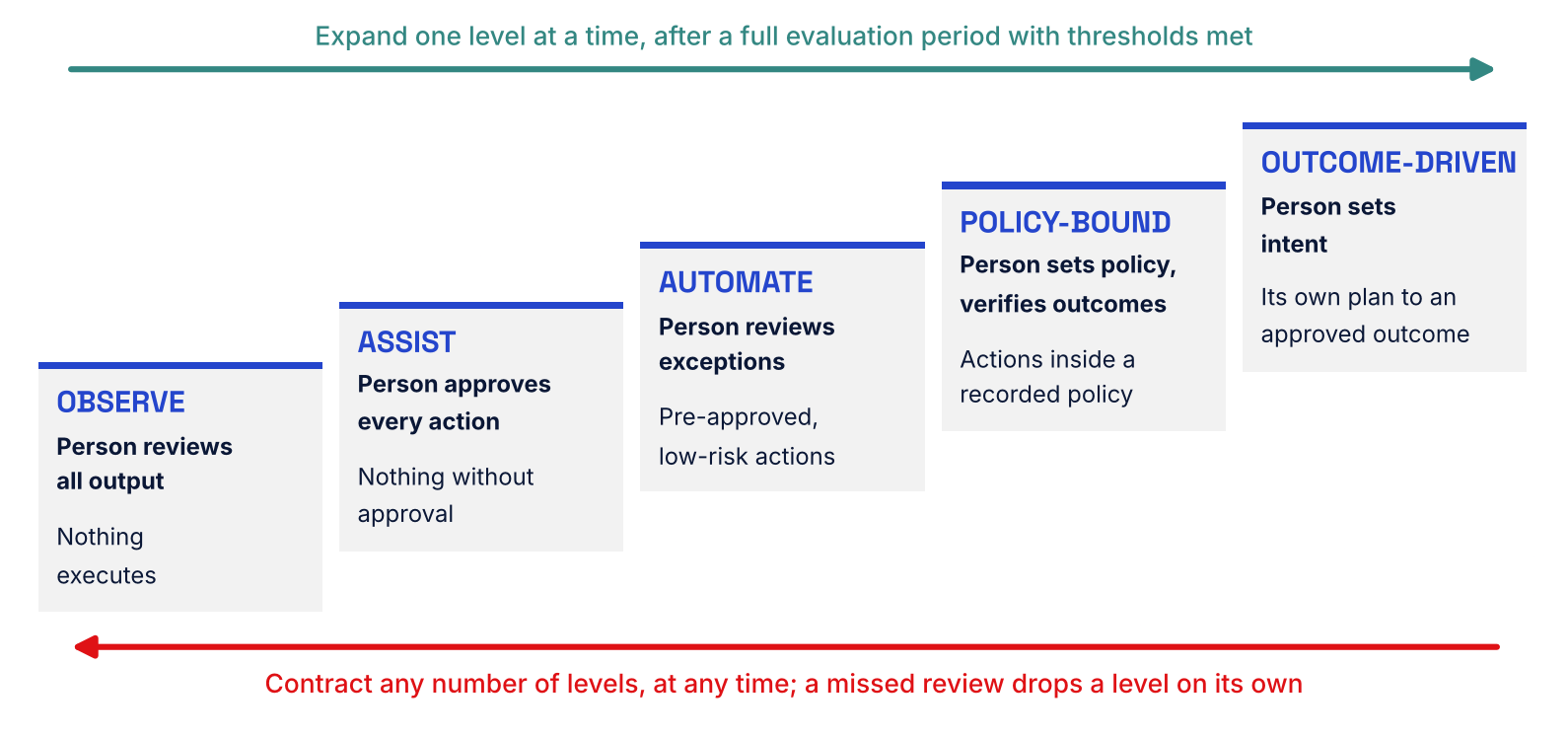
Autonomy is earned one level at a time and can be pulled back at any time.
A few rules keep the ladder honest:
- Climb one rung at a time, and only after a full evaluation period at the current rung with every threshold met.
- Drop as far as needed, immediately. Pulling back autonomy should never wait for a meeting.
- Let silence count. If a review date passes without a decision, the workflow loses a level on its own. Trust that nobody is checking is not trust.
- Prove the way back first. Above Assist, a workflow should have a defined and rehearsed rollback before it gets the autonomy that might require one.
- Start new production workflows low. Observe or Assist, then let them climb on evidence.
THE LOOP THAT RUNS IT
Mechanically, continuously adaptive trust is a closed loop with three stages.
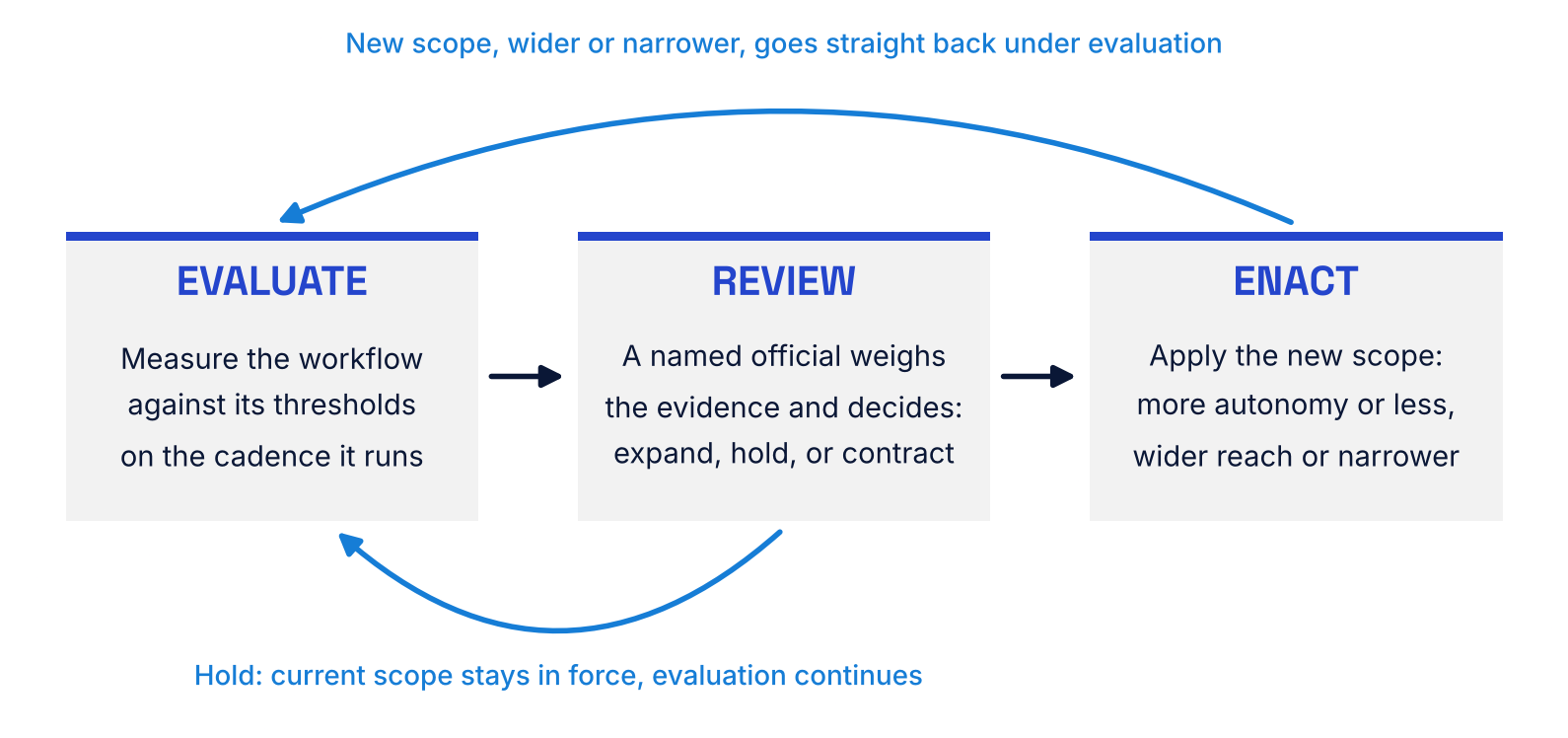
The trust loop. Nothing approved stays approved by default.
Evaluation measures the workflow against its stated thresholds while it runs. Review puts that evidence in front of a named official who decides whether to expand, hold, or contract its scope. Enactment applies the decision. When the official holds the current scope, the workflow keeps running at the level it has already earned, and evaluation simply continues. When the scope changes, wider or narrower, the new scope goes straight back under evaluation. Reviews happen at the end of each evaluation period and whenever conditions change, such as a new threat, a control failure, or a business change.
None of this requires automation. Evaluation can be an analyst pulling the same figures every week, and a decision can be a signature on a change ticket. What the model needs is a defined cadence, defined thresholds, and a named person acting on the result. A fully manual program can run it today.
WHY THIS MATTERS MORE WITH AI AGENTS
Agentic SOC tooling makes the grant-once model much harder to defend. An agent's behavior depends on models, prompts, tools, and data that can change underneath it between one week and the next. NIST's AI Risk Management Framework organizes AI risk work into four functions, Govern, Map, Measure, and Manage, and frames them as ongoing rather than one-time activities.
Continuously adaptive trust gives each of those functions a concrete job inside the SOC:
- Govern: a named person owns every agent's authority. Each agentic workflow has an official who decides what it may do until a set review date. The agent can recommend widening its own scope but only that person can approve it.
- Map: every grant has a defined scope, and every action has a known blast radius. The authorization states where the agent may act: which environment, which assets or tenants, which actions, during which hours. Before each automatic action, the agent works out what it would touch, meaning the identities, entitlements, assets, and systems involved.
- Measure: the agent is evaluated continuously against stated thresholds. Every action, automatic or approved, is recorded the same way: its verdict, its confidence, its impact, its outcome, and the authorization it ran under. Those records are the evidence for every trust decision.
- Manage: authority moves on that evidence, in both directions. The official expands, holds, or contracts the agent's scope at each review. A breached threshold or a missed review contracts it automatically, and a tested rollback is in place before the agent gets the autonomy to need one.
WHERE TO START
- Inventory the trust you have already granted. List every workflow that acts without per-action approval.
- Name an owner for each one's trust decisions. One person, not a committee.
- Write down thresholds and an evaluation period. For example, false-positive rate, rollback success, and time to verdict, measured over a set number of days or executions.
- Put a review-by date on every grant. Decide in advance what happens if it passes unreviewed.
- Rehearse rollback for anything that acts without per-action approval.
- Review on evidence. Expand, hold, or contract, and record why.
The goal is not less automation. Teams that can show the evidence behind every grant of autonomy can move faster, because they can extend trust with confidence and pull it back without drama. Trust earned continuously is trust you can defend to your board, your auditors, and yourself.
Learn how Anomali can help you earn trust. Schedule a demo.
FEATURED RESOURCES
TRUST SHOULD BE EARNED… OR LOST
When the Email Goes Down, Operations Don't Have to
