Threat Intelligence vs. Threat Intelligence Platform: How the Enterprise Security Brain Learns
Threat Intelligence vs. TIP Overview
Threat intelligence is analyzed information about adversaries, their capabilities, and their intentions, delivered in a form security teams can act on. A Threat Intelligence Platform (TIP) is the system that ingests, normalizes, scores, and distributes that intelligence across the security stack.
Without a TIP, intelligence arrives as disconnected feeds in incompatible formats. A TIP automates the pipeline so analysts act on curated, enriched data instead of stitching sources together manually.
Security Teams Don't Have a Data Problem, but They Do Have an Operationalization Problem
Most security teams already subscribe to threat intelligence feeds. The challenge is making that data actionable at scale.
● Feeds arrive in inconsistent formats across vendors
● Indicators are duplicated, stale, or missing context
● Manual triage cannot keep pace with alert volume
● Intelligence never reaches the tools that need it
As environments scale, these gaps compound. Analysts spend more time managing feeds than using them to stop threats.
A Threat Intelligence Platform addresses this directly by operationalizing intelligence across detection, investigation, and response.
Why Organizations Are Moving to a TIP
Security leaders need to do more without adding headcount. Manual intelligence workflows are not built for this level of scale.
A TIP helps teams:
● Operationalize intelligence faster by automating ingestion, deduplication, and scoring
● Reduce analyst workload by suppressing low-confidence indicators before they generate alerts
● Improve consistency by distributing curated intelligence directly to SIEM, EDR, andSOAR
● Scale operations without adding manual triage overhead
How a TIP Turns Raw Data Into SOC Action
A TIP operationalizes intelligence through five core steps:
● Ingestion and normalization: Pulls feeds from commercial providers, open-source repositories, ISACs, and internal sources. Normalizes everything into STIX 2.1.
● Deduplication and scoring: Collapses duplicate indicators across sources. Scores each IOC by source reliability, recency, and corroboration. Suppresses low-confidence indicators.
● Enrichment and attribution: Adds adversary context like threat actor attribution, MITREATT&CK technique mappings, related campaigns so analysts understand who is using an indicator and why.
● Distribution to controls: Pushes curated intelligence to the SIEM as detection content, to firewalls as block lists, and to SOAR playbooks for response automation.
● Threat hunting and investigation: Provides a searchable, enriched repository analysts can pivot across during investigations, from a single IOC to related infrastructure and campaign timelines.
When You Need Both — and Why
Threat intelligence without a TIP is insight you cannot act on at scale. A TIP without quality intelligence is infrastructure withnothing to process.
Organizations with fewer than five intelligence sources and small analyst teams can often manage feeds manually. But as source count grows, a TIP moves from optional to operationally necessary, typically when a team subscribes to three or more external feeds alongside internal telemetry.
Regulated industries such as financial services, healthcare, and critical infrastructure typically reach this threshold earlier due to sector-specific threat sharing obligations through ISACs and frameworks like CISA’s Automated Indicator Sharing (AIS) program.
Key Findings From Anomali Research
Anomali’s platform processes billions of indicators daily across enterprise customers globally. Several operational patterns emerge consistently:
● 70%+ of alerts generated from raw intelligence feeds are duplicates or low-confidence indicators that a TIP filters before they reach the SIEM.
● 3× faster mean-time-to-detect (MTTD) reported by organizations integrating a TIP with their SIEM versus those using manual indicator workflows.
● 60%reduction in analyst time spent on manual IOC triage after deploying a TIPwith automated scoring and distribution rules.
● Hundreds of threat actor profiles — including APT groups and financially motivated actors — maintained and continuously updated in Anomali ThreatStream’s curated repository.
Frequently Asked Questions
What is the difference between threat intelligence and a threat intelligence platform?
Threat intelligence is the data itself: indicators of compromise, adversary TTPs, vulnerability context. A threat intelligence platform (TIP) is the system that ingests, normalizes, scores, and distributes that data so security teams can act on it. You need both: quality intelligence and a platform to operationalize it.
Do I need a TIP if I already subscribe to threat intelligence feeds?
Yes, once you subscribe to multiple feeds. Feeds deliver raw indicators, but without a TIP those indicators sit in spreadsheets or siloed tools. A TIP aggregates feeds, removes duplicates, scores relevance, and pushes actionable indicators directly into your SIEM, firewall, EDR, and SOAR, automatically.
How does a TIP improve SOC efficiency?
A TIP reduces analyst alert fatigue by filtering low-confidence indicators before they reach the SIEM, enriches alerts with adversary context automatically, and enables threat hunting against a curated, searchable intelligence repository. The result is a measurable reduction in mean time to detect and respond.
How does Anomali ThreatStream differ from other TIP products?
Anomali ThreatStream Next-Gen combines one of the industry’s largest curated intelligence repositories with agentic AI capabilities that automate indicator triage, enrichment, and investigation workflows. It integrates natively with Anomali’s Unified Security Data Lake, so intelligence and detection operate within a single platform rather than as separate point solutions.
Key Concepts Behind Threat Intelligence and TIPs
A TIP builds on core capabilities including threat intelligence aggregation, STIX/TAXII normalization, MITRE ATT&CK mapping, and security data integration.
For a deeper look at how these concepts work together, explore the glossary.
See How a TIP Works in Practice
Adopting a Threat Intelligence Platform is not just about adding a new tool. It is about transforming how your team consumes, operationalizes, and acts on intelligence at scale.
Anomali ThreatStream Next-Gen is designed to help organizations reduce investigation time, improve detection confidence, and scale intelligence operations without increasing overhead.
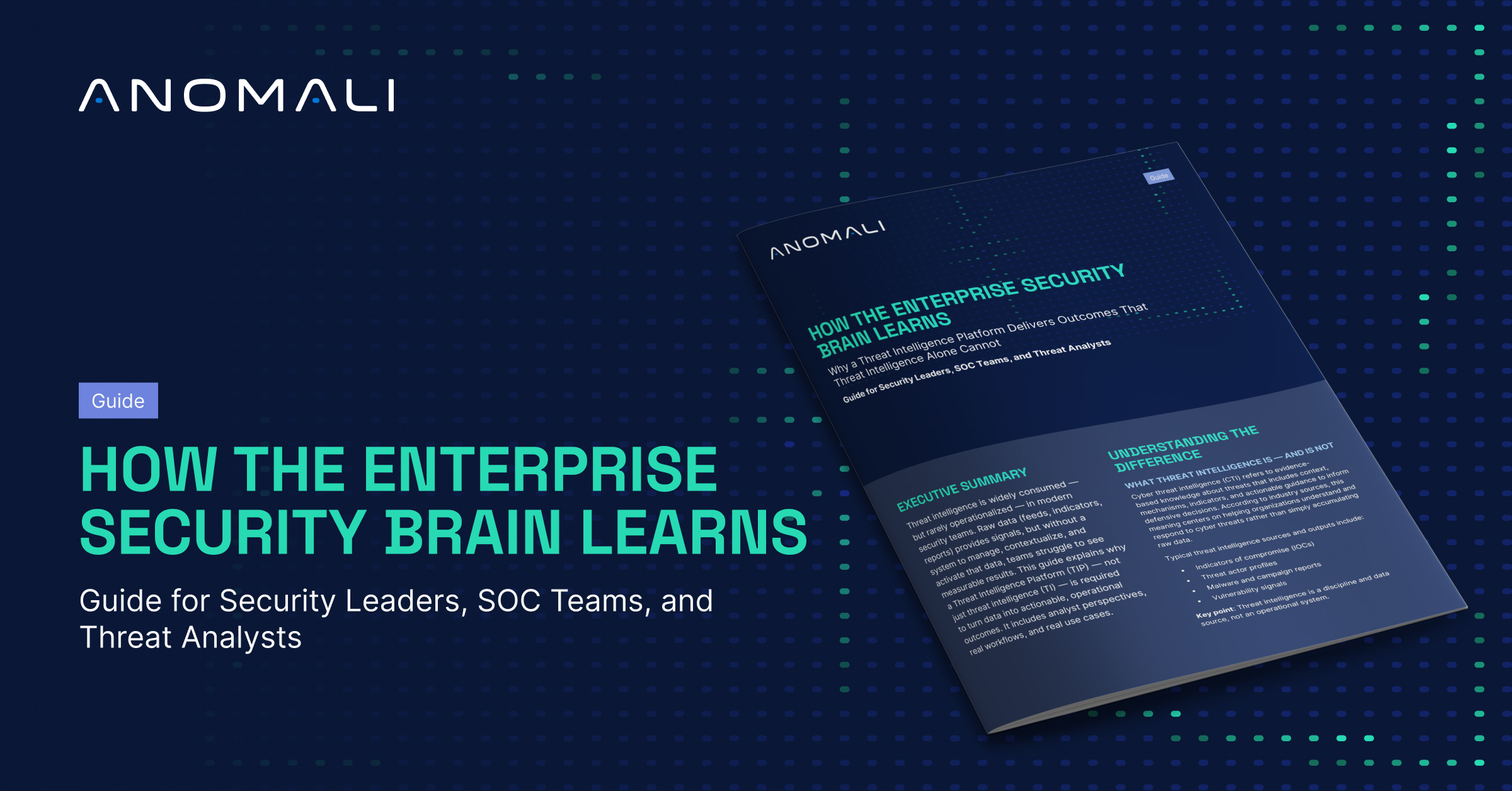
Download the guide to see how leading security teams are operationalizing threat intelligence in real-world environments.
Discover More About Anomali
Check out some of our other great resources covering the latest cybersecurity trends, threat intelligence, security and IT operations, and Anomali product updates.