What Is an Agentic SOC? Practical Guide to AI-Driven Security Operations
Agentic SOC Overview
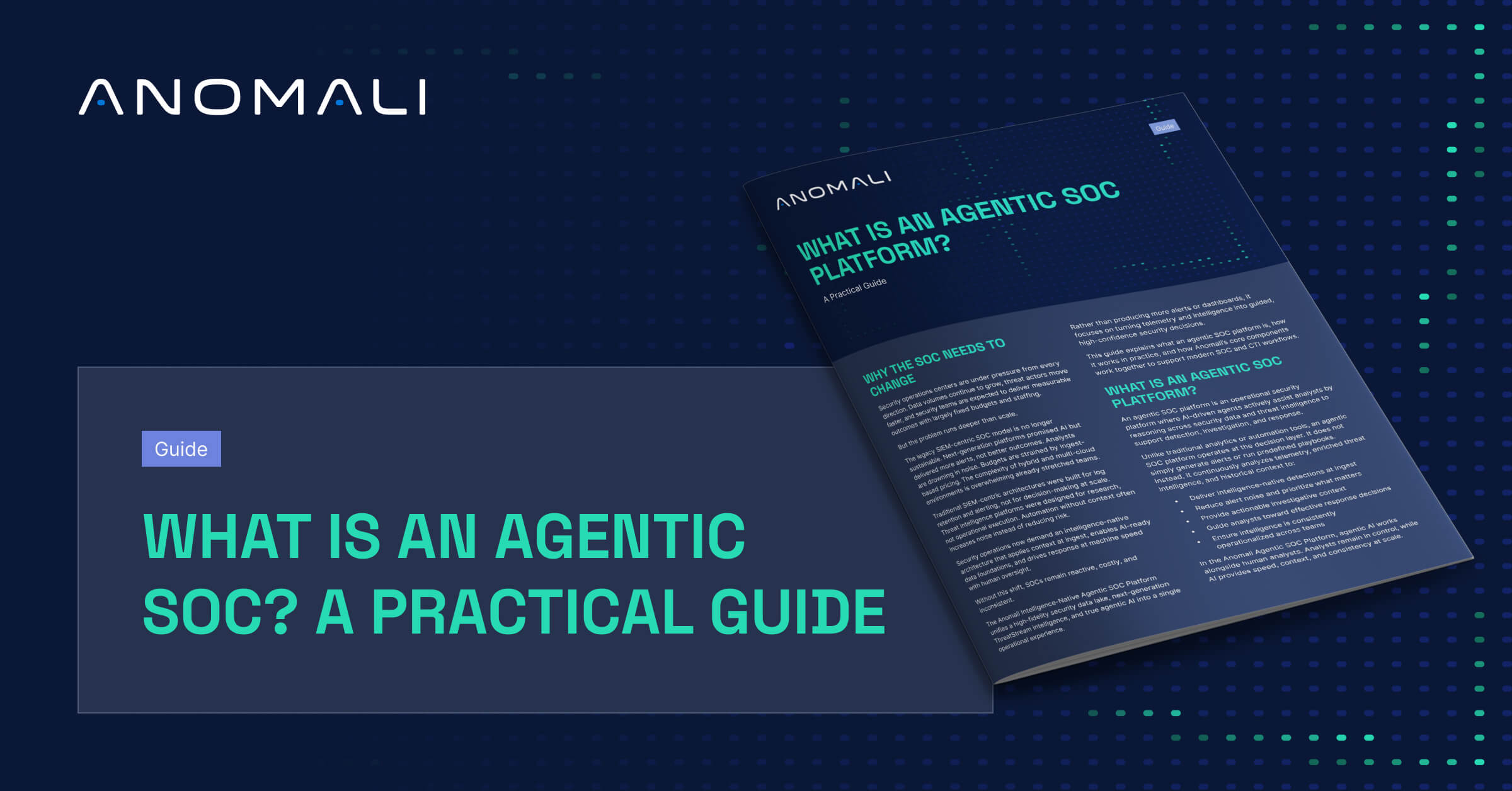
An agentic SOC is a modern approach to security operations where AI-driven systems analyze security data and threat intelligence to prioritize alerts, guide investigations, and recommend response actions.
Instead of relying on manual triage and static workflows, security teams can make faster, more consistent decisions with the right context already in place.
Security Teams Don’t Have a Visibility Problem — They Have a Decision Problem
Most SOC teams have already invested in tools to collect and correlate data. The challenge now is operational.
- Too many alerts
- Not enough context
- Slow, manual investigations
- Inconsistent response decisions
As environments scale, these issues compound. Analysts spend more time sorting through noise than resolving real threats.
Agentic SOC addresses this gap directly by improving how decisions are made across detection, investigation, and response.
Why Organizations Are Moving to Agentic SOC
Security leaders are under pressure to increase efficiency without increasing headcount. Traditional approaches are not built for this level of scale.
An agentic SOC helps teams:
- Prioritize real threats faster by analyzing signals in context
- Reduce analyst workload by minimizing manual triage
- Improve consistency across investigations and response actions
- Scale operations without adding complexity
How the Anomali Agentic SOC Platform Supports Real-Time Decisions
The Anomali Agentic SOC Platform is designed to operationalize this model in production environments.
It brings together three critical capabilities:
- Unified security data to ensure complete visibility across environments
- Integrated threat intelligence to provide real-world context
- AI-driven analysis to connect signals, prioritize alerts, and guide action
The result is a system that helps teams move from reactive workflows to faster, more informed decision-making at scale.
From Manual Workflows to Guided Operations
Traditional SOC workflows depend on analysts to piece together context across multiple tools. Even with automation, most processes still rely on predefined rules.
Agentic SOC introduces a more adaptive approach:
- Traditional SOC: Analysts drive triage and investigation manually
- Automated SOC: Playbooks execute predefined workflows
- Agentic SOC: AI-driven systems guide prioritization and next steps
Instead of asking analysts to find the signal, the system brings the signal to them.
Impact Across Detection, Investigation, and Response
Agentic SOC improves performance across the entire security lifecycle.
Detection
Signals are evaluated together, reducing noise and surfacing higher-confidence threats earlier.
Investigation
Relevant context is surfaced automatically, reducing time spent pivoting across tools.
Response
Recommended actions help accelerate containment while maintaining analyst control over critical decisions.
This leads to faster resolution times and more consistent outcomes across the SOC.
Key Concepts Behind Agentic SOC
Agentic SOC builds on core capabilities such as AI-driven analysis, threat intelligence, and data normalization.
For a deeper look at how these concepts work together, explore the glossary.
See How Agentic SOC Works in Practice
Adopting an agentic SOC isn't just about adding new technology. It is about improving how your team operates under pressure.
The Anomali Agentic SOC Platform is designed to help organizations reduce investigation time, improve decision quality, and scale operations without increasing overhead.
Download the guide to see how leading security teams are applying this model in real-world environments.
Discover More About Anomali
Check out some of our other great resources covering the latest cybersecurity trends, threat intelligence, security and IT operations, and Anomali product updates.