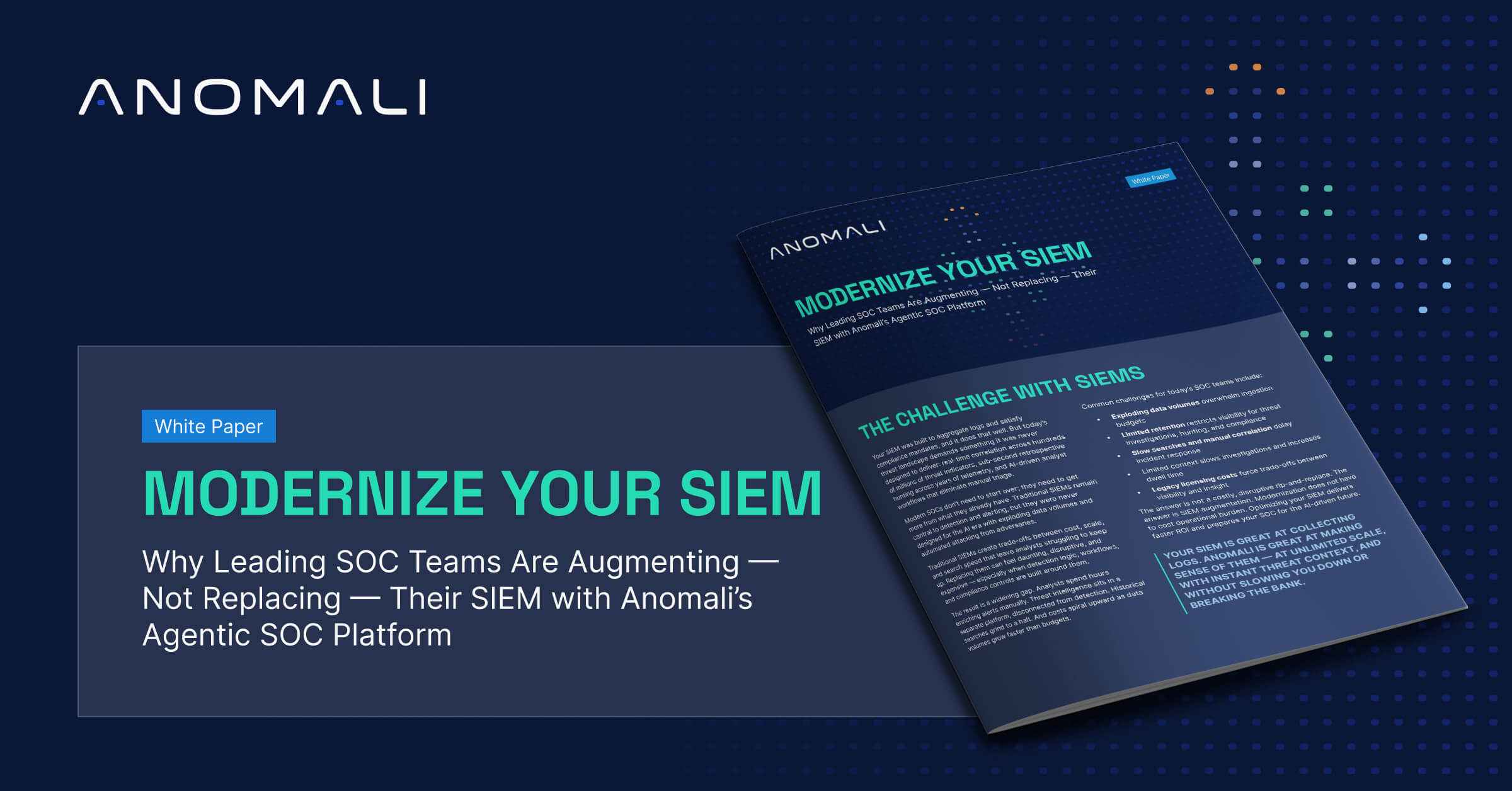
Modernize Your SIEM
Your SIEM is great at collecting logs. It was never built for billions of IOCs, sub-second hunting across years of data, or AI-driven triage. This paper shows how leading SOCs are closing that gap by layering on top, not starting over.
WHAT YOU'LL GET FROM IT
• A framework for deciding between two augmentation patterns (sit-on-top vs. selective offload) and which one fits which budget pressure.
• A side-by-side of where today's SIEMs run out of room —IOC limits, storage caps, per-GB ingestion — and the architectural moves that get around each one.
• A four-step rollout plan that doesn't require amigration project, paired with the KPIs to measure against.
• A composite healthcare case study showing thebefore/after of a 38% SIEM renewal hike — including how dwell time on anunmonitored OT device went from 47 days to 4 hours.
• The math behind the up-to-60% TCO number, broken into the three levers that actually drive it.
WHO IT'S FOR
SOC leaders, security architects, and CISOs running a SIEM (Splunk, Sentinel, QRadar, Elastic, Exabeam, Sumo Logic, or similar) who are facing a renewal, a data-volume problem, or a hunting/visibility gap and want a path forward that isn't rip-and-replace.
FAQ
Is "augmentation" a real long-term model,or a soft entry to migration?
Both, by design. Anomali customers run alongside their SIEM indefinitely; that's the supported model. Some eventually consolidate further; some never do. The paper lays out the augmentation patterns specifically so you can stay there if that's the right fit.
What happens to our detection rules, dashboards, and SOAR playbooks?
They stay where they are. The augmentation model is explicit on this point: "no retraining, no re-architecture, no disruption." Your SIEM keeps doing what it does today; Anomali adds the analytics and intelligence layer alongside it.
Discover More About Anomali
Dive into more great resources about the Anomali Security and IT Operations Platform, cybersecurity challenges, threat intelligence, and more.