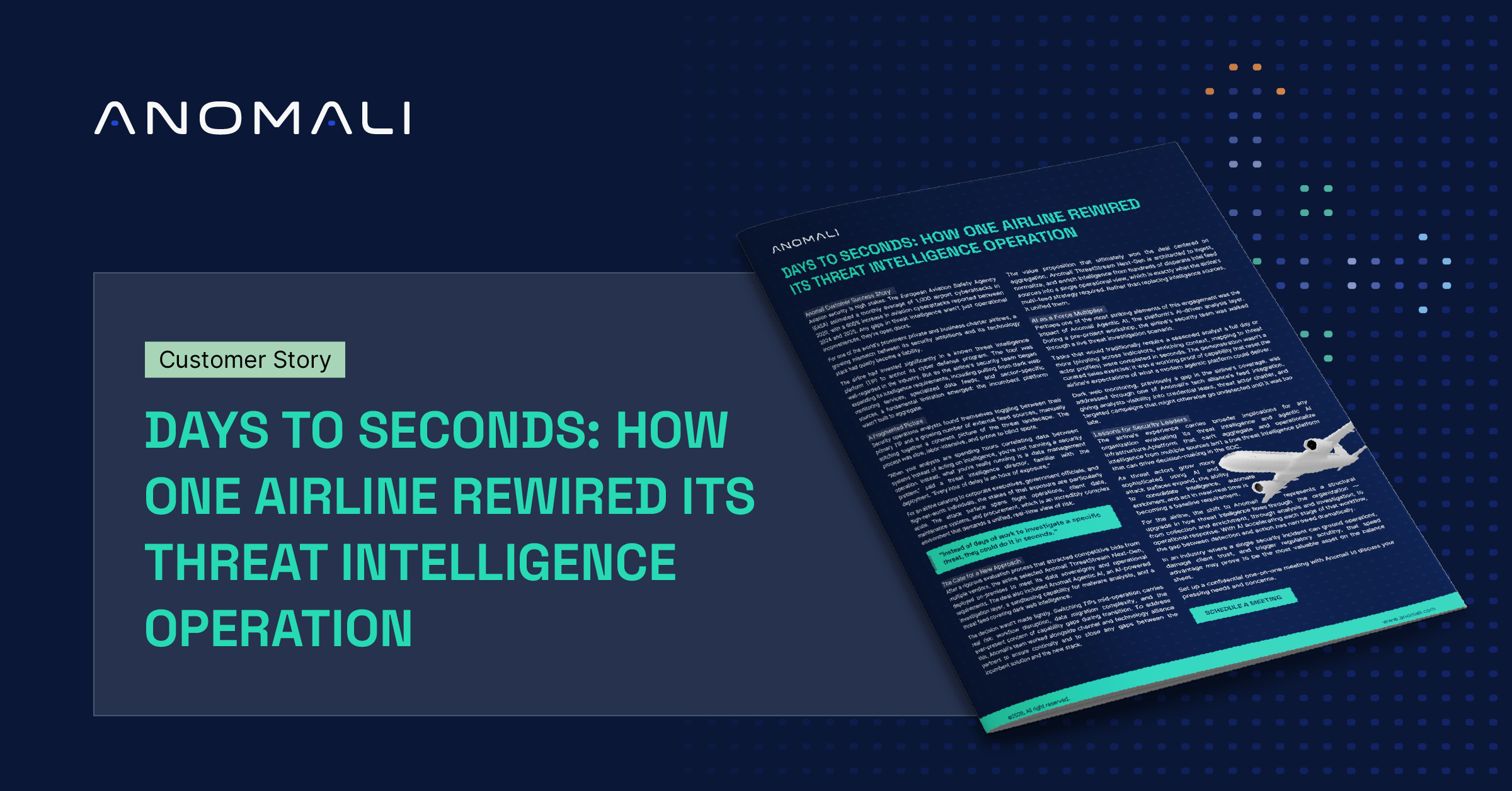
DAYS TO SECONDS: HOW ONE AIRLINE REWIRED ITS THREAT INTELLIGENCE OPERATION
A private charter airline replaced a fragmented, multi-tool threat intelligence stack with Anomali ThreatStream Next-Gen, cutting investigation time from days to seconds and closing gaps in dark web coverage.
What Problem Did This Airline Face?
One of the world's prominent private and business charter airlines had invested in a leading threat intelligence platform (TIP) to anchor its cyber defense program. As the security team expanded its intelligence requirements — adding dark web monitoring services, specialized data feeds, and sector-specific sources — a critical limitation surfaced: the incumbent platform could not aggregate across sources.
Security operations analysts were manually toggling between their primary TIP and a growing number of external feeds, hand-stitching a threat picture that was slow to assemble and prone to blind spots.
The airline's attack surface spans flight operations, client data, maintenance systems, and procurement. That complexity demands a unified, real-time view of risk, not a patchwork of disconnected tools.
Why Did the Airline Choose Anomali ThreatStream Next-Gen?
After a competitive evaluation with multiple vendors, the airline selected Anomali ThreatStream Next-Gen, deployed on-premises to meet data sovereignty and operational requirements. The full solution included:
- Anomali ThreatStream Next-Gen — ingests, normalizes, and enriches threat intelligence from hundreds of disparate sources into a single operational view
- Anomali Agentic AI — an AI-powered investigation layer that automates indicator pivoting, context enrichment, and threat actor mapping
- Sandboxing capability — for malware analysis
- Dark web intelligence feed — monitoring for credential leaks, threat actor chatter, and targeted campaigns
The core value proposition was aggregation: rather than replacing existing intelligence sources, Anomali unified them,
What Are the Key Outcomes?
- Investigation time reduced from days to seconds
- Fragmented multi-feed workflow replaced by a single, unified threat intelligence view
- Dark web coverage gap closed through integrated feed partnerships
- On-premises deployment meets data sovereignty requirements
- AI-accelerated workflow compresses the gap between detection and response across collection, enrichment, analysis, and operational action
What Should Security Leaders Take Away?
A threat intelligence platform that cannot aggregate and operationalize intelligence from multiple sources cannot drive effective SOC decision-making. As threat actors grow more sophisticated — leveraging AI to scale attacks — the ability to consolidate intelligence, automate enrichment, and act in near-real time is becoming a baseline requirement, not a differentiator.
For this airline, Anomali represents a structural upgrade in how threat intelligence flows through the organization: from collection and enrichment, through analysis and investigation, to operational response.
In an industry where a single security incident can ground operations, damage client trust, and trigger regulatory scrutiny, speed of detection and response may be the most valuable asset on the balance sheet.
Schedule a confidential one-on-one meeting with Anomali to discuss your threat intelligence requirements.
More Case Studies
Check out more examples below of how organizations are using Anomali's Security and IT Operations Platform.